
Table of Contents
- A Practical Guide to Ranking Higher on Google
- Cost Questions About Google Rankings
- Process Questions About Improving Google Rankings
- Code and Permit Questions for SEO
- Timeline for Google Ranking Improvements
- Still Have Questions?
A Practical Guide to Ranking Higher on Google
A practical guide to ranking higher on Google starts with creating helpful, people-first content. Google’s systems reward sites that provide original value rather than using manipulative tactics. In this introduction, we outline the foundational principles and actionable steps you need to understand how to rank your website higher by following official guidelines.
The Google Search Central team explains that in regard to quality, they focus on Trust more than anything. Therefore, in order to rank higher on Google, you’ll need to work on demonstrating your credible expertise and building your audience’s confidence with clear and transparent content and/or media.
When you consistently apply the people-first practices, you’ll discover how to improve SEO ranking across your pages, leading to more organic traffic and business growth. After reading this, you may wonder how much it costs to reach and maintain higher ranking positions.
Key Takeaways
- “Organic rankings” is Google’s term for search results that don’t require payment to Google for placement.
- Google’s official guidance says the way to improve search rankings is strikingly simple: produce helpful, reliable content designed primarily for people, not content engineered to manipulate search results.
- We recommend taking a structured approach to technical SEO because these elements lay the foundation for how search engines discover, comprehend, and rate web content.
- Setting the foundations of a site correctly will help inform the timeline for the remaining changes.
Cost Questions About Google Rankings
“Organic rankings” is Google’s term for search results that don’t require payment to Google for placement. Google’s statement on placement confirms that results placement is free, as long as the requirements are technically met.
There are three requirements for a site to be eligible for free inclusion in Google Search. The first is to allow Google’s web crawler, Googlebot, to access relevant pages and not block it with directives in the robots.txt file or with authentication gateways (for example, login walls). The second is to get a successful page load. This is indicated by an HTTP status of 200. The last is to contain indexable content in a supported file type and meet Google’s policies on spam. These conditions must be met to establish a foundation for eligibility; they do not guarantee that a particular page will appear for specific queries, but they establish the necessary conditions for free inclusion in the index.
The algorithms that determine Google search results rely on several factors unrelated to payment. The independent system that controls paid search results creates advertisements that appear at the top and bottom of search results pages. These advertisements are easily distinguishable from organic results, and Google’s algorithms rely on other factors to determine organic search results. The API and documentation provide no means to influence organic visibility through payment. Furthermore, Google publicly states that organic search rankings cannot be purchased.
Many companies hire SEO providers like us at Super Intelligence Group because optimizing the technical, content, and authority signals Google’s algorithm evaluates requires specialized expertise and sustained effort. Although the cost of ranking itself is essentially zero, producing quality content, earning trustworthy backlinks, and maintaining a technically sound site are meaningful operational investments that sites must make in order to be visible in organic search results. This operational investment allows sites to rank well in Google’s free, algorithm-based search results.
Process Questions About Improving Google Rankings
Google’s official guidance says the way to improve search rankings is strikingly simple: produce helpful, reliable content designed primarily for people, not content engineered to manipulate search results. Structuring processes to achieve this is the true means to rank higher in Google.
While E-E-A-T (Experience, Expertise, Authoritativeness, Trustworthiness) is not a ranking factor in the classic sense, Google’s systems rely on these factors to determine if content is valuable. Trust (T) is the most important factor of the framework. In our studies, pages that provide real-world experience fare better in the long term.
To align with these principles, we advise:
- Disclose automation transparently. If you use AI or automation to help create content, explain how and why—this openness aligns with Google’s emphasis on trust and helps users assess credibility.
- Reject deceptive authorship. Fabricated author bios, fake credentials, or AI-generated headshots undermine authority. Google’s systems flag such tactics as low-quality signals that can harm performance.
- Ignore arbitrary word counts. Google has no preferred content length; writing purely to reach a target word count is a hallmark of a search-engine-first approach and should be avoided.
- Build on SEO fundamentals. The same practices that support traditional rankings—clear site structure, readable text, proper indexing—also position your site for visibility in AI-driven search features.
These same principles impact how to show up in Google’s AI Overviews. As stated in Google Search Central, there are no unique requirements or structured data to appear in AI-enhanced results. Using standard means like robots.txt, meta tags and other directives remain the key ways to control access to traditional search vs. AI search.
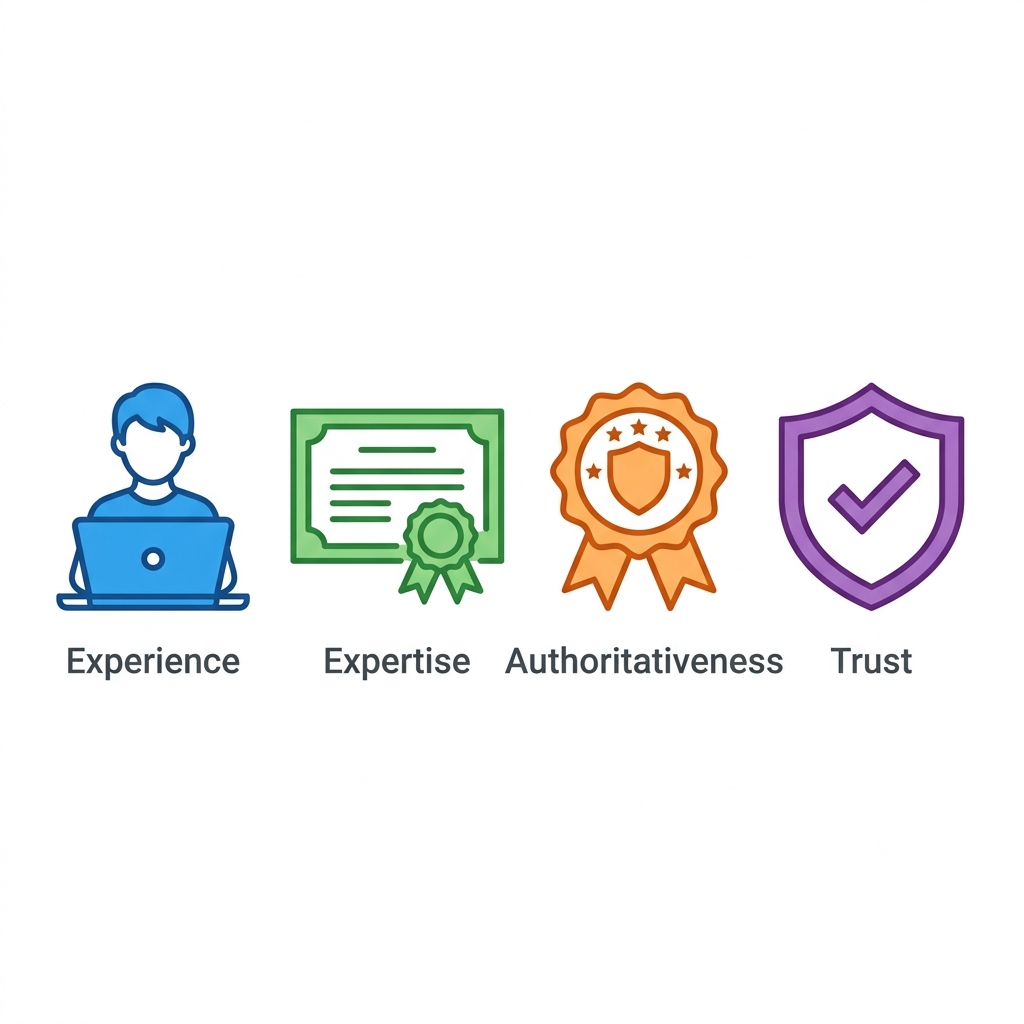
A people-first content and transparency-focused approach creates a steady foundation for the more technical and structural work that follows like on-page elements and code.
Code and Permit Questions for SEO
We recommend taking a structured approach to technical SEO because these elements lay the foundation for how search engines discover, comprehend, and rate web content. Google’s Published Search Guidelines say that even the highest quality content may go undiscovered if the basis for technical SEO isn’t in place.
Canonical tags let web developers point Google to the primary version of a page when there are multiple copies of the same content. Google suggests that proper canonicalization ensures the search engine invests its crawl budget in the version that matters most.
XML sitemaps let Google know the important pages on a site and are useful for pages that contain different types of media, for example, pages with videos, pictures, etc. Google Search Central suggests that the use of XML sitemaps leads to a complete index of a site’s core content.
Mobile-friendliness has become a critical ranking factor since Google switched to a mobile-first index, using a mobile crawler by default for all websites. With over 60 percent of the global internet population accessing the web through mobile devices, this factor is no longer optional and directly impacts search performance.
Understanding the differences between robots.txt and noindex is necessary for managing crawl permissions. The robots.txt file blocks crawling of private or low-value sections, while the noindex meta tag is the correct tool for preventing pages from appearing in search results entirely.
Unique title tags and meta descriptions for each page directly influence click-through rates by providing clear, distinct snippets in search results. Crafting descriptive, page-specific titles helps both users and search engines understand what each page offers, improving the likelihood of relevant clicks.
Using schema.org markup and other structured data along with semantic HTML provides search engines with more context about the information and improves your search listings. Google states that using structured data improves how search results are displayed.
We will spend the remainder of this module understanding how quickly these optimizations will impact search engine results page rankings.
Timeline for Google Ranking Improvements
Setting the foundations of a site correctly will help inform the timeline for the remaining changes. Pages of a site need to be discovered and indexed by Google before they can appear in search results. Once Google discovers a site, the crawlers need to efficiently process the site and the content on it to prioritize what’s important. Using canonical tags, clean 301s, and submitting accurate sitemaps to Google will all help Google’s crawlers process a site the way the site owners want it to be processed.
Sites must now be mobile friendly and use HTTPS as baseline requirements for ranking improvements. Google uses a mobile crawler, meaning sites that are not optimized for mobile or that do not have an SSL/HTTPS connection may see slower ranking improvement regardless of other efforts. According to Google’s official Search Central guidelines, these factors are tightly woven into the evaluation of user experience, and sites that ignore them often struggle to gain traction even when content quality is otherwise strong.
Sites can optimize for Page Experience to meet Google’s requirements in website performance and interactivity, reduce site abandonment, and help qualify for improvements in ranking. In the same vein, if a site has made the foundations for AI Search/AI Overview, it can rely on the same foundational best practices for ranking.
Ranking improvements are never instantaneous, and no credible SEO timeline can promise a fixed number of days or weeks. Competitive density, content depth, and the frequency of Google’s recrawl cycles all determine how soon the effects of technical upgrades become measurable. Some changes may propagate within days when the site is already well-established and technically sound; others take much longer when high-authority competitors dominate the query space or when the site is new to Google’s index. Setting realistic expectations means treating SEO as a continuous process of refinement rather than a one-time fix.
If you would like a timeline estimate tailored to your site, reach out to us.
Still Have Questions?
Even after reading this practical guide to ranking higher on Google, you may still have specific questions about your website’s expected timeline and the factors that influence your ranking path. Because every website is unique, the path to higher rankings can differ from general timelines, and we are here to help you navigate your specific situation. Contact us for a free, no-obligation website SEO analysis by calling (202) 733-6214 or emailing info@superintelligencegroup.us; our team looks forward to providing the personalised guidance you need.
Resources
- Create People-First Content with Google Helpful Guidelines
- Learn Technical SEO Requirements for Google Indexing
- Master Google Search Webmaster Guide for SEO
- Learn How Google AI Search Overview Works
- Learn Why Fake Author Bios Signal Low Quality
- Follow Developer SEO Guide for Search-Friendly Websites