Table of Contents
- International SEO FAQ for Global Brands
- Understanding International SEO Pricing and ROI
- How International SEO Services Work for Global Brands
- Technical Code Requirements for Multilingual SEO
- Timeline for International SEO Results
- Still Have Questions About International SEO?
International SEO FAQ for Global Brands
International and multilingual SEO for global brands is the practice of optimizing a website to rank in search engines across multiple countries and languages. In today’s interconnected markets, this discipline is essential for any brand seeking to compete globally. A global SEO agency must adapt strategies to different cultural search behaviors, local search engine algorithms, and language nuances to maintain worldwide visibility.
This FAQ addresses common questions about our international SEO services, covering how we implement worldwide SEO services tailored to each target country, integrate multilingual SEO services for precise language-targeting, and adapt to local search engine preferences. Our mission is to help global brands connect with audiences in every language and region. These answers draw on our expertise in tailoring international SEO strategies for diverse markets. Our SEO platform, an AI-powered system that accelerates global visibility. We then examine the costs and ROI of international SEO campaigns to help you make data-driven decisions.
Key Takeaways
- To enter into global markets you need to know what affects investment levels and how to measure the return on that investment.
- Understanding pricing is just the first step; knowing how the services work is equally vital for global brands.
- After implementing hreflang and language tags, our clients often ask us about timing and results.
Understanding International SEO Pricing and ROI
To enter into global markets you need to know what affects investment levels and how to measure the return on that investment.
What Factors Influence International SEO Pricing?
When it comes to international and multilingual SEO for global brands, it is vital to have a good understanding of the major factors that influence pricing. The level of complexity for international SEO can vary, and is typically determined by the number of markets targeted, the amount of content which needs to be localized, the level of technicality of multiple sites, and the agency’s expertise. A model which we have found to be quite effective is the pay-per-keyword model, which allows flexibility to scale SEO spending based on specific markets without a fixed retainer.
How Can I Measure the ROI of International SEO Services?
To know the potential costs of international and multilingual SEO, measuring ROI calls for analytics that isolate performance by country: set up per-country conversion goals so traffic, lead, and revenue signals from each market aren’t commingled, and use filters based on hostname or top-level domain so a visitor from France isn’t counted in your U.S. metrics. To measure marketing KPIs, a good starting point is to look at organic traffic growth per language, local keyword rankings, and lead quality.
What’s Included in a Comprehensive Worldwide SEO Services Package?
A typical international SEO package includes a technical audit to identify crawl and indexation issues across multiple domains or subdirectories, proper hreflang tag implementation to signal language and regional targeting, localized content creation that respects cultural nuances, link building from authoritative sites within each target region, ongoing optimization based on ranking data, and transparent reporting that breaks out results by country. While no two providers deliver exactly the same mix, the core elements should always include a clear, distinct strategy for each market you’re pursuing. Ultimately, a comprehensive package ensures your global presence is AI-powered, search-ready, built to grow. With pricing and ROI considerations in mind, understanding how those strategies are executed across languages and markets is the natural next step.
How International SEO Services Work for Global Brands
How Do International SEO Services Differ from Domestic SEO?
Understanding pricing is just the first step; knowing how the services work is equally vital for global brands. International SEO differs from domestic SEO because it must account for multiple languages, cultural nuances, and varying search engine preferences. Understanding how global brands expand through international SEO reveals why hreflang tags, localized content, and regional link building are essential. Our international SEO methodology addresses these complexities by integrating native-language keyword research and culturally relevant content that resonates with each audience. This contrasts with local SEO agencies that focus on a single region; a true global agency must demonstrate experience across multiple geographies and the ability to adapt to platforms like Baidu or Yandex.
How Do Global SEO Agencies Build Links Across Different Territories?
The global SEO process for link acquisition relies on geo-targeted outreach that identifies high-quality, niche-relevant websites in each target market. We secure one-way inbound links through local directory citations, industry partnerships, and editorial placements that signal authority to regional search engines. Rather than using automated spam, we prioritize human-reviewed link building where every link is vetted for relevance and trust. AI-assisted platforms help scale the prospecting while maintaining the quality control that earns sustainable rankings across borders.
How Do Experts Manage Multi-Regional Content Complexity?
Managing multi-regional content requires a structured architecture that uses subdirectories or subdomains to organize country-specific or language-specific content, along with hreflang tags that signal to search engines which version to serve. Not every global brand needs entirely separate websites; a well-planned directory structure can consolidate authority while still targeting unique audiences. Content hubs that centralize global messaging while localizing regionally ensure that brand voice remains consistent. Additionally, experts must optimize for different search engines—Google for most of the West, Yandex for Russia—each with its own ranking factors and technical preferences. This means adjusting on-page elements, metadata, and server configuration to meet local technical standards.
Why Is Native-Language Keyword Research Essential for Global Brands?
Direct translation of keywords from English into other languages often ignores the subtle cultural and colloquial nuances that drive real search behavior. Native-language keyword research uncovers the exact terms, long-tail phrases, and local expressions that buyers actually use, ensuring content aligns with genuine intent rather than literal translations. True localization goes beyond converting words; it adapts the entire message to cultural references, measurement units, and regional sensitivities. Once the native keywords are mapped, they inform an international SEO strategy that relies on technical configurations to handle multilingual signals effectively.
Technical Code Requirements for Multilingual SEO
This section covers the technical aspects of making multilingual websites search-friendly.
How Should Global Brands Implement Hreflang Tags Correctly?
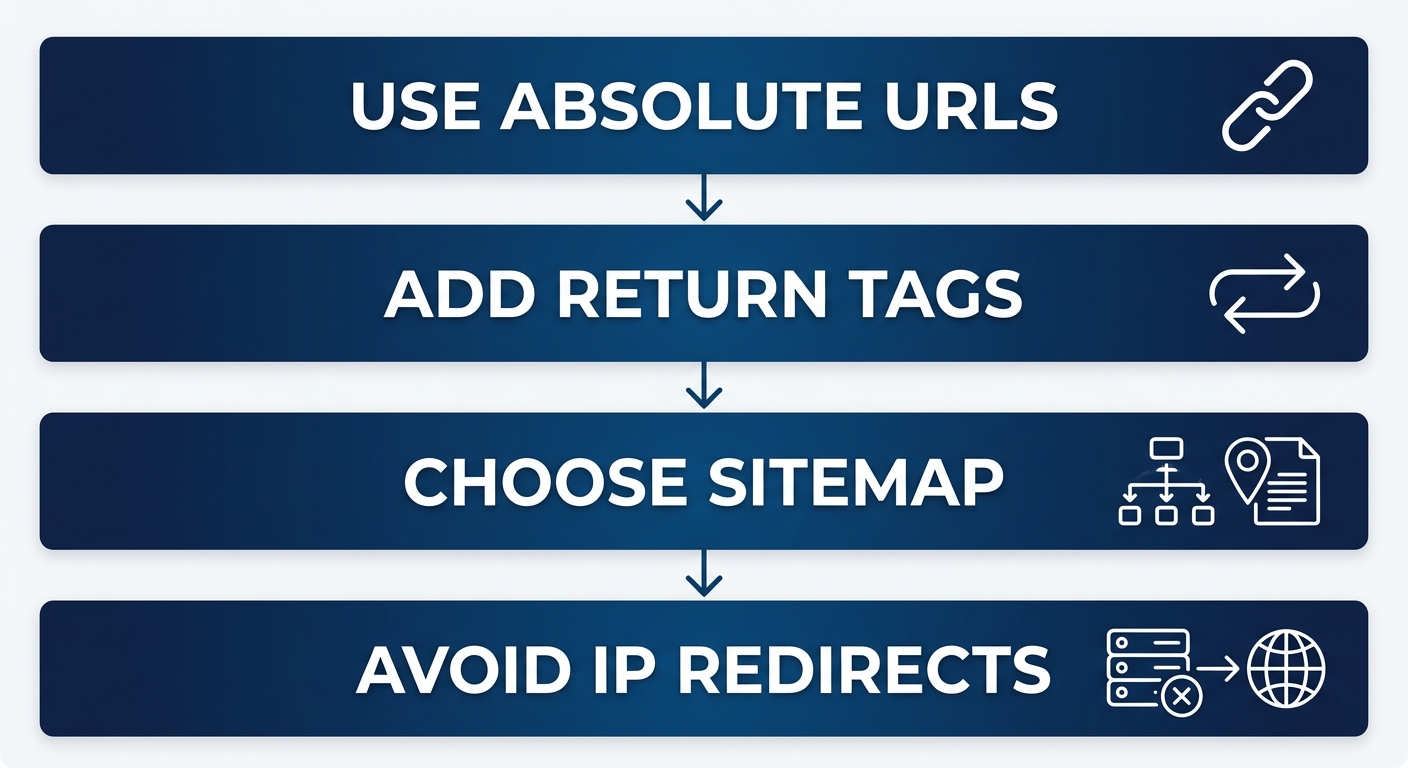
A proper implementation of hreflang avoids duplication of content due to localized and regional variants. It tells search engines which variant to show users. Hreflang annotations require the use of absolute URLs (i.e. https://example.com/fr/) and include the appropriate ISO language and region codes (i.e. fr-CA for French-Canada). A mandatory return tag is required: if page A points to page B, page B must point to page A. Google and Yandex accept two methods of implementation of the hreflang annotations: link elements in the HTML head or hreflang tags in XML sitemaps. IP-based redirects should not be used for language content detection since they may block crawlers which operate from different regions.
What URL Structures Maximize Authority Across Countries?
ccTLDs (such as .fr) are the strongest signals for geo-targeting and building user trust. However, they require separate registrations and manageability. Subdirectories such as example.com/fr/ consolidate link equity and simplify administration compared to subdomains such as fr.example.com. From an organizational standpoint, subdomains can be better. A consistent, multilingual URL structure aids search engines in consolidating ranking signals.
Do International SEO Services Include Hreflang and Canonical Tag Setup?
As part of our international SEO service, we address hreflang and duplicate content. We configure hreflang and canonical tags, audit reciprocal return tags, implement canonical rules to prevent duplicate content, and validate implementations in HTML and XML sitemaps. We address common hreflang issues and ensure x-default fallback is implemented. We provide this service on a pay-per-keyword, cancel-anytime basis. Proper configuration aids in the speed at which international markets are accessed and fosters trackable international growth.
Timeline for International SEO Results
After implementing hreflang and language tags, our clients often ask us about timing and results. We have to manage expectations. International SEO results are by nature incremental, and come in phases, not necessarily in monthly or quarterly cycles.
What Is the Typical Timeframe to See Results from International SEO?
Early wins may surface in less competitive markets within weeks or a few months as search engines index localized pages. Notably, sustained ranking improvements across target countries require consistent content and link building — often many months of work. Because every global campaign faces different competition and authority levels, patience and consistent effort are essential.
What Factors Influence the Speed of International SEO Success?
The international SEO timeframe hinges on controllable factors. Strong domain authority and a healthy backlink profile give you a head start. Technical health — correct hreflang, mobile speed — removes ranking obstacles. Content that genuinely serves each locale keeps users engaged, and AI-search readiness matters more: AI-overviews can deliver quick visibility even as traditional rankings build. International SEO is a marathon; qualified help that proactively addresses these variables can shorten the curve. Our BRON and CADE offerings accelerate progress with niche-relevant backlinks and twice-weekly content built for AI-driven search. If you’d like to discuss your unique timeline and how our AI-powered approach can help, contact us for a realistic, data-backed plan.
Still Have Questions About International SEO?
Clients often ask us about international SEO timelines precisely because every global brand’s situation is different. If brand-growth questions remain after exploring these insights, our international SEO FAQ page addresses the queries we hear most often about international seo services questions. We tailor global brands multilingual SEO strategies to each market’s realities, and Super Intelligence Group is ready to help you plan international and multilingual SEO for global brands that fits your timeline.